Reviews
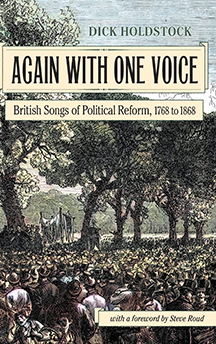 Author:Dick Holdstock
Book: Again With One Voice: British Songs of Political Reform 1768-1868
Publisher: Loomis House Press
Pages: 414
Website: https://loomishousepress.com/again-with-one-voice.html
This is an important collection of songs - and that's a prime understatement! For this book is so much more than that. Tho' the title, its air of academia and its strictly defined time-span may betoken a volume of potentially somewhat specialist interest, even a cursory glance through its pages will instigate an eager plunge down the rabbit-hole of investigation! The key to the book's immediate appeal is likely to reside in its twofold nature - as Steve Roud observes in his foreword, it concerns two equally important topics: political reform and songs and singing. But I'd take that observation a stage further - the book's lasting appeal, and the secret of its success (and in the final analysis its importance), is that it covers and links both of these topics so brilliantly, cohesively and comprehensively, with the result that it escapes the trap of falling between the two and failing to satisfy the enthusiast of either. For whether in matters of detail, research, perspective or presentation, the book excels.
The inquisitive general reader will at first probably be asking - why this specific timeline? Well, I can do no better than quote the rear-cover text: "1768 saw the birth of a century of struggle for democracy by the working people of Great Britain; it was also the golden age of the broadside ballad - inexpensive songsheets sold on the street, often spotlighting popular figures and spreading the word of reform efforts." The ensuing 100 years was undoubtedly a highly significant and very tumultuous period, characterised by a powerful and vocal energy and a hitherto undreamt-of degree of commitment, a working-class struggle that, although invariably fuelled by desperation and anger, often expressed itself in songs (predominantly taking the form of broadside ballads) that might well exhibit a surprising degree of humour alongside or within their cutting social commentary.
The book traces, chronologically, the history of the period, each of its ten chapters taking its cue from a particular phase, concept or development of the stated theme within its time-frame. The consistency of format works well: each chapter's introductory essay is followed by several individual songs, generally of the broadside-ballad-cum-protest-song variety, many of which use - or are put straight to - popular song or dance tunes of the day (Lilibulero, Hard Times, Fathom The Bowl, The Girl I Left Behind Me, Vicar Of Bray etc.). Of course, in following the (tacitly) accepted practice of "songmaking" in this way, the resultant songs would inevitably be both more singable and more accessible to their target audience. Here in Dick's book, each example is clearly stave-notated with complete text and an explanatory commentary linking it to the events being sung about, telling their background stories. And as a bonus, instead of enclosing a CD with the book, Dick has made available through his website a set of free- download mp3s giving the tunes for all 120 songs. Sung in his own inimitable robust, rousing tones, even these snatches positively invite the listener/reader to join in and follow the songs; they inspire a singer's incorporation of these songs into his/her repertoire. The book's chapters are also punctuated with copious, relevant, attractive - and well reproduced - illustrations from contemporary publications, which further enhance the book's flavour, interest and readability.
Thematically, the net is cast far and wide, with songs concerning Wilkes and Liberty, the United Irish, the anti-slavery movement, Luddites, Captain Swing, the Naval Mutiny, anti-war movements, the Tolpuddle Martyrs, and the Chartist movement; songs that bring to life important figures like John Wilkes, Major Cartwright, Thomas Paine, Thomas Muir, Wolfe Tone, Henry Hunt, William Cobbett, Feargus O'Connor, and William Gladstone. The majority of the songs included in the book are virtually unknown - the most familiar are possibly Eight Shillings A Week and Ernest Jones' Song of The Lower Classes. And yet it's striking how much relevance they carry for today - notwithstanding the specifics of the historical references, events and contexts; in other words, though they are very much "of their time", their sentiments and messages aren't outdated. There are some very powerful songs here, and the majority transcend polemic.
This book will surely find a prominent place on the shelves of any institutional or personal library that concerns itself with British history and the working class struggle in particular, and is almost certainly destined to become the pre-eminent reference work in its field. Additionally, unlike many a serious academic study, it has a wide and diverse potential readership, including social and political historians and students of radical political thought. But its unique selling-point could be considered its contribution to the study and practising singing of political song; any singer seeking fresh songs to revitalise his/her personal repertoire is bound to be inspired, enthused and enthralled by the contents of this handsomely presented and impeccably, exhaustively researched volume, a masterwork which has clearly been no less than a labour of love - and life - for the redoubtable Mr. Holdstock.
David Kidman
| Previous | Next |
|---|---|
| Elles Bailey: Shining In The Halflight | Le Vent du Nord: 20 Printemps |
Recent Reviews
- The Kilans:Could You Keep It Dark
- The Be Good Tanyas:Blue Horse 25th Anniversary Edition
- The 101ers:Joe Strummer 003: - The 101ers Years
- Ranagri:Say Hello
- Paul Walker And Karen Pfeiffer:Cheaper Than Therapy
- Bird In The Belly:Only Dogs As Friends
- Anna Moon & The Stars:Oh My God! It's A Resurrection
- Track Dogs:Still At The Music
- Malvenn:Chez Nous
- Kathy Zimmer:Little Tornadoes
Fatea Showcase Sessions

The Fatea Showcase Sessions are a series of downloads featuring acts that we've really enjoyed and think that more people should get the chance to hear.
Pirate is the current session and features 16 fantastic artists check out the website to find out more about them and download your copy
www.fatea-showcase-sessions.co.uk for all the artist information.